What you need
- Your annual electricity consumption in kilowatt hours from the last bill
- The planned or existing annual yield of the system
- The current price per kilowatt hour and the feed-in tariff
- A sense of when electricity is used in the household, during the day or in the evening
1Self-sufficiency rate and self-consumption share are not the same
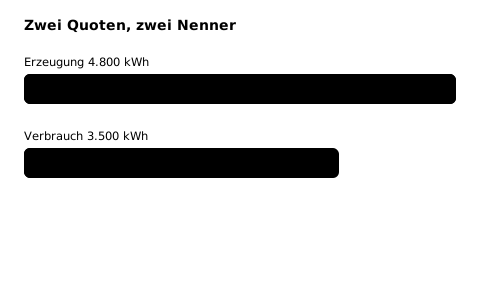
Both figures describe the same amount of energy, but with different denominators, and that is exactly why they are constantly confused.
The self-sufficiency rate says what share of your consumption comes from your own system. The formula: self-used solar power divided by total consumption. A household consuming 3,500 kilowatt hours that covers 1,300 of them from its own system has a self-sufficiency rate of 37 percent.
The self-consumption share says what share of your generation stays in the house. Formula: self-used solar power divided by total generation. The same system with 4,800 kilowatt hours of generation therefore reaches 27 percent.
The difference is not academic. The self-sufficiency rate is about how independent you are from the grid; that is the number most people mean when they say “self-sufficiency”. The self-consumption share is about how well you use your own electricity; that is the number that decides profitability, because self-used electricity saves the full purchase price while exported electricity only earns the much lower tariff.
A large system raises the self-sufficiency rate and at the same time lowers the self-consumption share. A small system does the opposite. Anyone wanting to maximise one of the two figures needs to know which.
2What a battery does, and what it does not
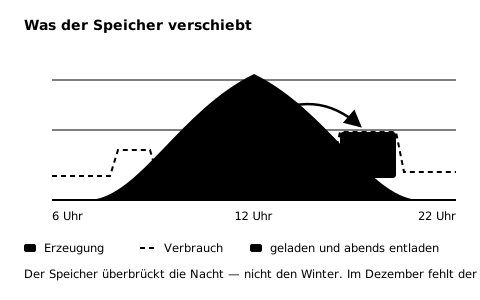
A battery shifts energy in time, from the midday peak into the evening. Nothing more. This one statement answers most questions about storage.
Without storage, solar power arrives when the typical household consumes the least. What is left over goes to the grid. In the evening, when people cook, heat and watch television, the electricity comes back from the grid, only more expensive. The battery fills exactly this gap.
From this follows the first limit: a battery can only shift as much as is surplus during the day and needed in the evening. In a household that consumes during the day anyway, working from home or a heat pump in daytime operation, there is less to shift, and the battery contributes correspondingly less.
The second limit is the season. In summer there is more surplus every day than the battery can hold; it is full at midday and empty in the evening, a perfect cycle. In December there is no surplus at all on many days; then the battery stays empty and contributes nothing. A battery bridges the night, not the winter. Seasonal storage with batteries is neither physically nor economically feasible; it would need a hundred times the capacity.
The third limit is losses. A lithium storage system returns around 90 to 95 percent of the charged energy; with inverter losses in both directions the system as a whole retains about 85 to 90 percent. Ten charged kilowatt hours become a good nine usable ones.
3How big the battery should be
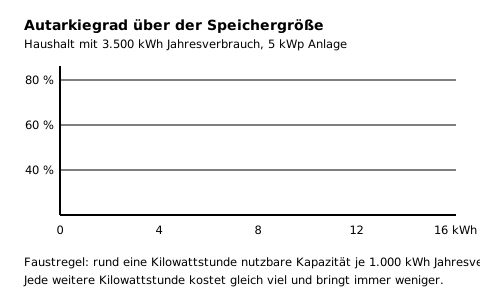
The most common rule of thumb: around one kilowatt hour of usable storage capacity per 1,000 kilowatt hours of annual consumption. A household with 3,500 kilowatt hours ends up at 3.5 kilowatt hours, one with 5,000 at 5.
A second, similarly good rule refers to the system: around one kilowatt hour of storage per kilowatt peak. With typical sizing both lead to similar sizes, because system and consumption usually match.
What matters is what happens beyond this size. The curve of the self-sufficiency rate over battery size rises steeply at first and then flattens clearly. For our example household, the jump from zero to 3.5 kilowatt hours brings around 28 percentage points of self-sufficiency. The jump from 3.5 to 7 brings only about twelve, from 7 to 14 another eight. Every additional kilowatt hour costs the same.
The reason is simple: the first part of the battery is fully used on almost every day of the year. The upper part only on the few days when there is enough surplus and enough evening consumption, never in winter, not always in summer. An oversized battery stands half empty most of the time and ages anyway.
In practice this means: for the first purchase, stick to the rule of thumb. Many systems can be expanded later if a heat pump or an electric car is added and actually increases evening consumption.
4What self-sufficiency rate is realistic?
Without storage, an average household with a suitably sized system reaches a self-sufficiency rate of 25 to 35 percent. The value is higher if someone is at home during the day and lower for a classic commuter profile.
With a battery sized by the rule of thumb, the values rise to 55 to 70 percent. That is the order of magnitude reputable quotes work with. Anything above requires either a much larger system, a much larger battery or consumption that can be shifted heavily into the daytime.
Above 80 percent annual self-sufficiency is practically unreachable in Central Europe without disproportionate effort. The reason is in the monthly distribution: November to February together deliver only around 14 percent of the annual yield. In these months the electricity comes almost entirely from the grid, no matter how big the battery is.
Conversely, full self-sufficiency for weeks is normal in the summer half of the year. Anyone watching their system in July and extrapolating to the year gets a completely wrong picture, the same trap as with the yield forecast.
A good self-sufficiency rate is not an end in itself, by the way. It costs money, and beyond a certain point you buy independence at a higher price than grid electricity costs. Anyone who wants self-sufficiency out of conviction should know that and decide consciously; anyone who calculates stops earlier.
5Does the battery pay off?
The benefit of a battery is a single number: the difference between what a kilowatt hour from the grid costs and what it would have earned when exported. At 35 cents purchase price and 8 cents tariff that is 27 cents per shifted kilowatt hour.
How many kilowatt hours a battery shifts per year follows from its usable capacity times the number of full cycles. Realistic are 200 to 250 full cycles a year, almost one a day in summer, hardly any in winter. A battery with 5 kilowatt hours of usable capacity therefore shifts around 1,000 to 1,250 kilowatt hours, about 900 to 1,100 after system losses.
Multiplied by 27 cents that gives an annual benefit of around 240 to 300 euros. If the battery costs 4,000 euros, the simple payback is 13 to 17 years, close to the typical warranty period of ten years or 6,000 to 10,000 cycles.
This calculation is sensitive to three quantities. If the electricity price rises, the battery quickly becomes more attractive. If the battery price falls, likewise. And the more evening consumption the household has, the more cycles add up. Anyone running a heat pump or an electric car calculates much more favourably than a two-person household without either.
What does not belong in the calculation: the system itself. Photovoltaics as a rule pays off much faster than the battery, usually in eight to twelve years. Considering both together obscures the fact that they are two separate investment decisions. You can build the system and retrofit the battery later.
6How long does it take to fill the battery?
The charging time follows from the surplus, not from the system power. What matters is what is left after the running household consumption is deducted.
An example: a 5 kWp system on a clear June day delivers about 4 kilowatts around midday. The base consumption of the house is 0.4 kilowatts. That leaves 3.6 kilowatts of charging power. A battery with 10 kilowatt hours of usable capacity is therefore full in just under three hours, provided it was empty and the system's charging power allows it.
That is exactly where the second limit lies: many home batteries charge at no more than 0.5 C, i.e. half their capacity per hour. A 10 kWh battery then takes in at most 5 kilowatts; with smaller systems the surplus is the bottleneck anyway.
In spring and autumn this stretches over the whole day, because output only reaches two to three kilowatts. In December the battery does not fill at all on many days.
For sizing, a simple test follows from this: if your battery does not fill on an average summer day, it is too big for your system. If it is full by mid-morning and the rest of the day is exported, it is too small, or the system too big.
7A complete example
A four-person household in Cologne consumes 4,200 kilowatt hours a year, mostly in the morning and evening. 6 kWp are planned on the south-west roof, the specific yield is around 958 kilowatt hours per kilowatt peak, giving 5,750 kilowatt hours of generation.
Without storage: self-consumption is about 28 percent of generation, i.e. 1,610 kilowatt hours. The self-sufficiency rate is 1,610 of 4,200, i.e. 38 percent. 4,140 kilowatt hours go to the grid.
With a battery by the rule of thumb, 4.2 kilowatt hours usable, rounded to a standard 5 kWh system: at around 220 full cycles and 88 percent system efficiency the battery shifts about 970 additional kilowatt hours into self-consumption. Self-consumption rises to 2,580, the self-consumption share to 45 percent, the self-sufficiency rate to 61 percent.
The financial effect: 970 kilowatt hours times 27 cents difference gives around 262 euros a year. At a surcharge of 4,000 euros for the battery, it pays off on paper in a good 15 years.
And the variant many overlook: putting the same 4,000 euros into more modules instead of the battery would bring about 3 kWp more on this roof and thus 2,870 kilowatt hours more generation, of which only a small part would be self-consumed. Which variant wins depends on the ratio of module price, battery price and feed-in tariff. You can play through exactly this calculation in SolarFinder by changing system size and battery independently of each other.
8Buy it now or retrofit later?
The system pays off faster than the battery. From this follows an obvious strategy: build the photovoltaics first, add the battery later when electricity price, battery price or your own consumption argue for it.
Technically there are two ways. An AC-coupled battery sits behind the inverter on the house grid and can be connected to practically any existing system, even one of a different make. It is slightly lossier, because the electricity is converted twice, but completely independent of the existing system. A DC-coupled battery sits in front of the inverter and works more efficiently, but requires a hybrid inverter, which must be there from the start or replaced later.
Anyone wanting to keep the retrofit open therefore buys a hybrid inverter straight away. The surcharge over a pure grid inverter is manageable and much smaller than a later replacement.
The main arguments against waiting are subsidies and installation. If the battery is installed together with the system, the effort is incurred once: scaffolding, electrician, registration with the grid operator. Later, some of that recurs. Whether that outweighs the advantage of the later, usually cheaper battery depends on the quote.
A third option is often overlooked: no battery at all, but shifting consumption instead. Running the washing machine, dishwasher, hot water heating and electric car charging in the midday hours raises self-consumption about as much as a small battery, and costs nothing but habit.
9Emergency power, backup power and what the battery actually provides
Many people buy a battery expecting to stay supplied during a power cut. That is not a given. On the contrary: a standard battery switches off when the grid fails.
The reason is a safety regulation. Inverters must disconnect when the grid fails so that nobody works on a supposedly dead line while the system keeps feeding in. Without additional technology, even a system with a full battery therefore stands still as soon as grid power is gone.
There are two upgrade levels that change this. The emergency power function provides a single socket after the outage, usually with limited power and with an interruption of a few seconds to minutes. It is enough for fridge, router and lights. The backup power function, on the other hand, supplies the whole house via a transfer switch and, depending on the system, can even work without interruption. It is considerably more complex and expensive, because a grid disconnect switch and suitable wiring are needed.
Both must be ordered with the purchase. Retrofitting is technically possible with many systems but expensive, because it intervenes in the house installation. Anyone who wants the battery as backup should decide that before choosing and see it explicitly in the quote; the terms are often used loosely in sales.
For the profitability calculation the function plays no role: it saves no kilowatt hour, it increases availability. Anyone who wants it buys comfort and security, not return.
10Common mistakes
Confusing self-sufficiency rate and self-consumption share. Both figures describe the same amount of energy with different denominators and lead to opposite conclusions.
Sizing the battery for a summer day. Anyone choosing the capacity to cover a June day buys too much for eleven months.
Using gross instead of usable capacity. There are often ten percent between the two.
Hoping for seasonal self-sufficiency. The battery bridges the night, not the winter; a factor of a hundred is missing for that.
Mixing battery and system in one calculation. The system pays off much faster; added together, the battery looks better than it is.
Assuming too many full cycles. 300 and more cycles a year are only reached by households with very high evening consumption; 200 to 250 are realistic.
Frequently asked questions
What does self-sufficiency rate mean?
The self-sufficiency rate is the share of your electricity consumption that you cover from your own system: self-used solar power divided by total consumption. Not to be confused with the self-consumption share, which states the self-used share of generation.
How do I calculate the self-sufficiency rate?
Divide self-used solar power by total consumption and multiply by 100. Example: 1,300 kWh from the system at 3,500 kWh consumption gives 37 percent. For the self-consumption share you divide the same 1,300 kWh by generation instead.
What self-sufficiency rate is good?
Without storage 25 to 35 percent, with a battery sized by the rule of thumb 55 to 70 percent. Above 80 percent as an annual average is only reachable in Central Europe with disproportionate effort, because November to February together deliver only around 14 percent of the annual yield.
How big should the battery be?
As a rule of thumb around one kilowatt hour of usable capacity per 1,000 kilowatt hours of annual consumption, so about 4 kWh at 4,000 kWh. Alternatively one kilowatt hour per kilowatt peak of system power. Larger batteries bring much less additional self-sufficiency but cost the same per kilowatt hour.
Does a solar system with storage pay off?
The system almost always pays off, the battery only under certain conditions. Its benefit is the difference between purchase price and feed-in tariff, at 35 and 8 cents that is 27 cents per shifted kilowatt hour. A 5 kWh battery shifts around 1,000 kWh a year, about 270 euros. At a surcharge of 4,000 euros the payback is around 15 years.
How long does it take to fill a 10 kWh battery?
On a clear summer day with a 5 kWp system, around 3.6 kilowatts of charging power remain after household consumption, so the battery is full in just under three hours. In spring and autumn it takes all day, in December it does not fill at all on many days.
Does my battery work during a power cut?
Only with an emergency or backup power function. Without this additional technology the inverter disconnects for safety reasons when the grid fails, and even a full battery delivers nothing. Emergency power provides a single socket, backup power supplies the house via a transfer switch; both must be explicitly ordered with the purchase.
Can a battery bridge the winter?
No. A home battery shifts energy over hours, not months. Seasonal storage would need about a hundred times the capacity, which is neither technically nor economically feasible. In winter the electricity largely comes from the grid.
Is more storage or more modules worthwhile?
That depends on the ratio of module price, battery price and feed-in tariff. More modules increase generation, of which only a small part is self-used without storage; more storage increases the share used, but with diminishing returns. Best to calculate both variants with your own figures.
How many charge cycles does a battery achieve per year?
Realistically 200 to 250 full cycles: almost one a day in summer, hardly any in winter. Figures of 300 and more assume very high evening consumption, for instance from a heat pump or an electric car.