What you need
- A smartphone with compass and tilt sensor (almost every device since 2016)
- Alternatively: a map or a satellite image of your house
- For the tilt, as a substitute: a folding rule and a spirit level
- Optional: the floor plan or building drawings of the house
1What orientation and tilt really do
A solar system generates electricity from the radiation that actually hits the module surface. If the surface sits at an angle to the sun, the same radiation spreads over more area, and less arrives per square metre. That is exactly what orientation and tilt describe: how favourably the surface faces the sun over the day and over the year.
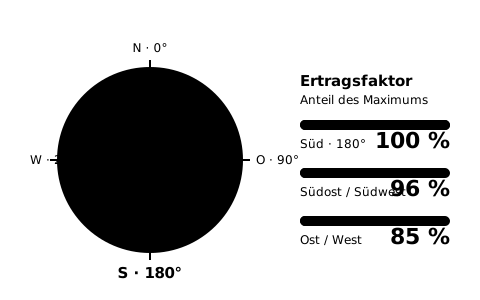
SolarFinder models this with an orientation factor. A surface facing exactly south gets the factor 1.00 and serves as the reference. South-east and south-west sit at 0.96, pure east or west at 0.85. Towards north the factor falls to 0.55; there a system only pays off in exceptional cases, for instance when a flat roof is available anyway and the tilt stays shallow.
Translated into money: building south-west instead of south loses roughly 50 to 60 euros a year on a 4 kWp system at an electricity price of 35 cents. That is noticeable, but no reason to reject a roof. Switching from south to east, on the other hand, loses around 15 percent, about 200 euros a year on the same system.
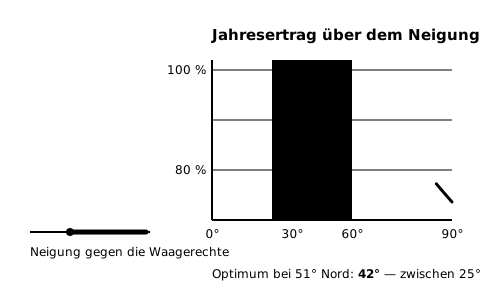
Tilt works in the same order of magnitude, but with one important peculiarity: its curve is very flat at the top. Between 25 and 55 degrees all values lie above 97 percent of the optimum. So you do not need to know the tilt to the degree, unlike the orientation, where a 30 degree deviation already shows measurably.
2Azimuth: the language of orientation
Calculators and professionals do not state orientation as “south” but as azimuth, an angle in degrees measured clockwise from north. North is 0 degrees, east 90, south 180 and west 270. A roof facing south-west therefore has an azimuth of 225 degrees.
Unfortunately there is a second convention in which south is zero and deviations towards east count negative, towards west positive. A south-west roof would be +45 degrees there. Both conventions are widespread; which one is meant is usually stated in small print next to the input. SolarFinder uses the first variant with north as zero, the same one your phone compass shows.
The reference point matters: what is always meant is the direction the module surface faces, i.e. the downhill direction of the roof pitch. Not the ridge direction, not the street side. On a gable roof with an east-west ridge, one half has azimuth 90 and the other 270.
A second pitfall is the difference between geographic and magnetic north. A compass points to the magnetic pole, which is not where the map has its north. In Central Europe this declination is currently around 3 to 5 degrees, negligible for the yield calculation, but good to know when two tools show slightly different numbers.
3Finding the roof orientation without tools
The fastest way is a satellite image. Open a map service, find your house and rotate the map so that north is at the top, which is the default. Now you see the roof ridge as a line. The module surfaces are perpendicular to it.
Mentally draw a line from the ridge downwards, at right angles to the ridge, in the direction of the roof surface you are interested in. The angle of this line against the vertical of the image is your azimuth: if it points down in the image, that is 180 degrees and thus south; if it points right, it is 90 degrees and thus east.
This method is surprisingly accurate, to about 5 degrees, if the satellite image is sharp and the roof has clear edges. It fails with complex roofs, with dormers and when trees hide the roof edges.
The second method without technology uses the sun. At true solar noon the sun is exactly in the south. In Central Europe that is between 12:10 and 13:40 depending on longitude and season; Central European Summer Time shifts it by one hour. At that moment stand so that your shadow falls straight behind you: then you are facing south. Compare this direction with the direction of your roof surface.
Both routes give a good approximation. If you want more precision or have a complex roof, measure directly on the building, which is the next step.
4Measuring with your phone: compass and calibration
Every modern smartphone has a magnetometer that feeds the compass. With it you can take the orientation directly on the roof or from below at the eaves: hold the device flat, point its top edge at right angles to the ridge in the direction of the roof surface and read off the azimuth.
The catch is accuracy. Magnetometers react to anything that creates or distorts a magnetic field: metal gutters, flashing, PV mounting structures, cars, the speakers in the device itself. Two metres of distance from larger metal parts can change the reading by ten degrees.
That is why every measurement should be preceded by a calibration. On most devices you move the phone through the air in a figure of eight for a few seconds until the reading settles. Then repeat the measurement at least once in a different spot. If the two values differ by more than five degrees, there is metal in the way.
Some devices do not provide an absolute north direction at all, only relative rotation. Then a reference point helps: point the device in a direction you know for certain, for instance the south direction from the noon method or a street whose course you have taken from the map, and set that value as the reference. SolarFinder offers all four cardinal directions for this, so you can pick the one that is easiest to determine on site.
5Measuring the tilt angle
The tilt is the angle of the roof surface against the horizontal. A flat roof has 0 degrees, a vertical facade 90 degrees, a typical Central European gable roof between 35 and 45 degrees.
With your phone this is easiest: the tilt sensor in every smartphone measures the inclination against gravity. Lay the device flat on the roof surface, or, if you cannot get onto the roof, on a surface parallel to it, such as a board held against the roof edge. The angle shown is the roof pitch.
Without a sensor, school maths is enough. Measure a horizontal distance of one metre on a rafter or on the gable wall and the corresponding height difference. The tilt angle is the arctangent of height divided by length. 100 centimetres horizontal and 84 centimetres vertical give around 40 degrees. For home use a rule of thumb suffices: 50 centimetres of rise per metre is about 27 degrees, 80 centimetres about 39, one metre exactly 45.
And if nothing else works: most building documents state the roof pitch directly. Roofers and carpenters can also tell you on request, because it depends on the roof covering: plain tiles need at least 30 degrees, concrete tiles about 22, metal sheeting manages with 10.
6The optimum tilt at your location
There is no universally optimum tilt angle; it depends on latitude. The further north, the lower the sun stands on annual average and the steeper the surface should be.
SolarFinder uses a simple, well-documented approximation for this: the absolute latitude times 0.76, plus 3 degrees, limited to a range of 10 to 45 degrees. For Berlin at 52.5 degrees north that gives around 43 degrees, for Munich at 48.1 degrees around 40, for Hamburg at 53.6 degrees around 44. Anyone living in Germany, Austria or Switzerland is never far off with 40 degrees.
What matters is how flat this curve runs. At 42 degrees the factor is 1.00. At 30 degrees it is 0.99, at 60 degrees 0.96. Even a completely horizontal flat roof still reaches 0.86; only the vertical facade drops off clearly at 0.70.
In practice this means: on a pitched roof the tilt is given, and it is almost always good enough. The question of the optimum angle only seriously arises on flat roofs and ground-mounted arrays, where the mounting angle can be chosen freely. And there it is often not the calculated optimum that wins but a shallower angle: less tilt means less shading between module rows and therefore more modules on the same area.
A second reason for shallower angles is the annual curve. A steep surface shifts the yield towards winter, because it catches the low sun better. That sounds attractive but helps little when only 2.2 percent of the annual yield falls in December anyway, compared with 13.5 percent in June.
7When south is not an option: east-west and the daily curve
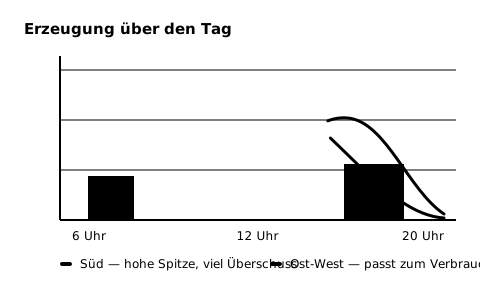
An east-west roof sounds like the worse deal: 85 instead of 100 percent. For the annual total that is true. For what ends up on the electricity bill, often not.
The reason is the daily curve. A south-facing system generates a lot of electricity in a narrow peak around midday, exactly when nobody is home in a typical household. The surplus goes to the grid and is paid at the feed-in tariff, which is well below the purchase price. An east-west system spreads the same energy over two flatter peaks: one in the morning, one in the late afternoon. That matches the consumption of people who have breakfast in the morning and cook in the evening much better.
Arithmetically, the self-consumption share shifts as a result. A south system without storage ends up at 25 to 30 percent self-consumption depending on the household, an east-west system at 30 to 40. With a difference between purchase price and feed-in tariff of around 27 cents, this effect can fully or partly offset the 15 percent lower yield.
There is also a practical advantage: on an east-west roof both halves can be used. Where a south roof carries 20 modules, east and west together carry 40. The smaller yield per module is compensated by more modules, provided the inverter is designed for it and the budget allows.
So the decision depends on what you want. Maximum annual yield per module argues for south. As much self-consumed electricity as possible and a more even generation curve argue for east-west.
8Shading beats any angle optimisation
Everything said so far applies to an unobstructed surface. As soon as a shadow comes into play, the orders of magnitude change dramatically, and downwards.
The reason lies in the wiring. Modules are connected in series in strings, and a string only delivers as much current as its weakest link lets through. A single shaded module can therefore throttle the whole string. Modern modules limit this to sub-areas with bypass diodes, and power optimisers or micro-inverters largely resolve it, but neither is free.
So before any question of angles, check: what stands to the south, south-east and south-west of the roof? Trees grow, and a neighbour's tree that is harmless today can hit the bottom row of modules in ten years. Chimneys, aerials, dormers, satellite dishes and neighbouring buildings belong on the same list.
The season is particularly treacherous. A shadow that just misses the roof in June lies right across it in October, because the sun then stands around 20 degrees lower. Anyone checking for shading should do so for winter, not for high summer.
If part of the surface is unavoidably shaded, the better answer is usually to leave that part free rather than rescue it with technology. A module that only delivers half the time rarely earns back its cost.
9Entering the values in the calculator
You now have two numbers: an azimuth in degrees and a tilt in degrees. In SolarFinder you enter them directly into the “Roof orientation” and “Tilt angle” sliders. If you do not want to measure by hand, open the app on your phone and let compass and tilt sensor capture both values in one go.
From these the calculator assembles the specific annual yield: the irradiation at your latitude multiplied by the orientation factor, the tilt factor and a performance ratio of 0.82. This 0.82 is the collective item for everything lost between module surface and meter: cable losses, inverter efficiency, temperature, soiling, ageing.
For context, each facing south at optimum tilt: Munich reaches around 1,101 kilowatt hours per kilowatt peak and year, Vienna 1,098, Cologne 998, Berlin 957, Hamburg 936. The difference between northern Germany and the Alpine foothills is therefore about 18 percent, more than the difference between south and south-west orientation.
Multiplied by the system size this gives the annual yield. A 4 kWp system in Berlin on a south-west facing roof with 40 degrees of tilt ends up at around 3,670 kilowatt hours a year.
10Common mistakes
Confusing the ridge direction with the orientation. What is meant is always the direction the surface faces; with a north-south ridge the surfaces face east and west, not north and south.
Measuring on the finished module array. Mounting structure and inverter distort the compass. Measure beforehand, or at a distance.
Trying to be too precise with the tilt. Between 25 and 55 degrees the curve is so flat that measurement accuracy does not matter. The time is better spent on the shading check.
Overlooking the winter shadow. Anyone checking in July is checking the most favourable situation of the year.
Writing off east-west across the board. The lower annual yield says little about how much electricity is ultimately self-consumed, and only that saves the full purchase price.
Taking the calculated optimum on flat roofs. Steep mounting costs area, because the rows otherwise shade each other. In practice 15 to 25 degrees win, although 40 would be better on paper.
Frequently asked questions
What orientation does my roof have?
Fastest via a satellite image with north at the top: the line at right angles to the ridge, in the direction of the roof surface, shows the orientation. More precise is the phone compass directly on the building, after calibration and at a distance from metal. The most accurate source is the north arrow on the floor plan in your building documents.
Which orientation is best for a solar system?
For the highest annual yield, south, i.e. azimuth 180 degrees. South-east and south-west still deliver about 96 percent of that, east and west around 85 percent. For the highest possible self-consumption, east-west can be the better choice despite the lower annual yield, because generation matches a household's daily curve better.
Is a solar system worthwhile on an east-facing roof?
Usually yes. An east roof delivers around 85 percent of the yield of a south roof, and because generation falls in the morning, a larger share of it is consumed directly in the house. It only becomes critical with additional shading or when only a very small area is available.
Which tilt angle is optimal?
It depends on latitude and lies between 40 and 44 degrees in Central Europe. In practice it hardly matters: between 25 and 55 degrees all values lie above 97 percent of the optimum. Even a horizontal flat roof still reaches 86 percent.
Can I measure the roof pitch with my phone?
Yes. The tilt sensor in every smartphone measures the inclination against gravity. Lay the device flat on the roof surface or on a board parallel to it. Without a sensor a folding rule is enough: one metre horizontal, measure the height difference, take the arctangent; 84 centimetres per metre is around 40 degrees.
What is the azimuth of a roof?
The azimuth is the compass direction as an angle, measured clockwise from north: north 0 degrees, east 90, south 180, west 270. It refers to the direction the module surface faces, not the direction of the ridge.
How much yield does a deviation from south cost?
Up to 45 degrees of deviation, i.e. up to south-east or south-west, around 4 percent. At 90 degrees, i.e. pure east or west, around 15 percent. Towards north the yield falls to about 55 percent; there, covering the roof only pays off in special cases.
Do I need to plan more modules for east-west?
If you want to reach the same annual yield, you need about 18 percent more module power. In return, both halves of an east-west roof can be used, and the inverter can be smaller, because east and west never deliver their maximum at the same time.